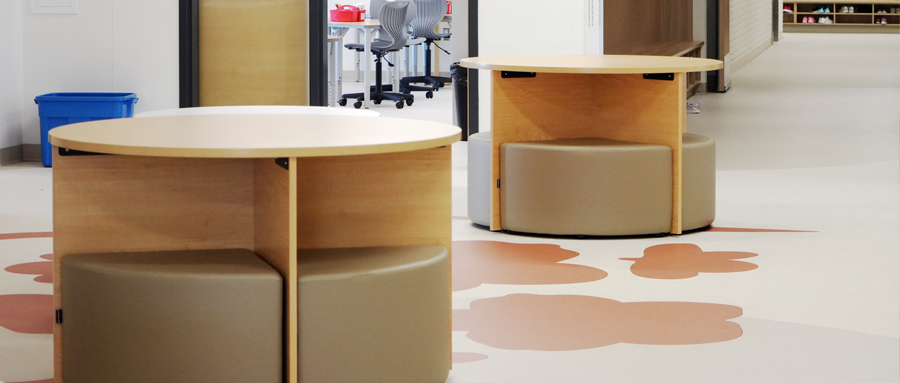
For decades, school hallways were designed with a single purpose: transit. They were efficient, straight paths meant to move students from Point A to Point B as quickly as possible. But as educational philosophy shifts toward student-directed learning and collaboration, schools are beginning to realize they are sitting on a massive untapped resource—their corridors.
In modern school architecture, the hallway is evolving into the "Third Place"—a space between the classroom and the playground where informal learning, socialization, and independent study can thrive. By reimagining these transient spaces as active "breakout zones," administrators can effectively expand their square footage and provide students with the variety of environments they need to succeed.
In this blog, we’ll explore how to transform underutilized corridors into vibrant learning hubs and why this shift is essential for the modern school.
The "Third Place" is a term originally coined by sociologist Ray Oldenburg to describe places where people spend time between home ('first' place) and work ('second' place). In a school context, the classroom is the 'work' environment. Students need alternative spaces where the pressure is lower, but the potential for engagement is still high.
Activating hallways provides these critical relief zones. Instead of sitting in a rigid row of desks, a student might take their laptop to a soft bench outside the library or meet a project partner in a quiet nook under the stairs. These spaces signal to students that learning happens everywhere, not just when a teacher is standing at the front of the room.
Not every hallway needs to be a learning zone, and safety codes must always be respected. However, pockets of "dead space"—such as widened corridor sections, lobbies, or alcoves—are perfect candidates for activation.
Furnishing a hallway comes with unique challenges. Unlike a supervised classroom, hallway furniture is often unsupervised and sees high traffic during passing periods. Durability is non-negotiable.
One of the biggest fears administrators have about hallway learning is noise. "If students are working in the hall, won't it disturb the classrooms?"
The answer lies in acoustic management. Traditional hallways are echo chambers of concrete and tile. By introducing soft seating, acoustic wall panels, and carpeted zones, you naturally dampen sound. Furthermore, when you provide designated, comfortable furniture, students tend to settle down and focus, rather than running or shouting.
Tips for Acoustic Control:
School construction is expensive, and every square foot of real estate should serve the student. By activating hallways, schools can reduce overcrowding in the library and cafeteria while offering students autonomy over how and where they learn.
When a student has the choice to step out of the classroom and work in a bright, comfortable corridor space, they feel trusted and respected. That shift in mindset is where true engagement begins.
Ready to activate your school's hallways?
Explore MityBilt’s range of Soft Seating and Conekt modular systems designed to turn any space into a learning place.
PO BOX 1158
20 Limestone Bay
Stonewall, MB
R0C 2Z0
T 204.467.5790
E solutions@mitybilt.com
Follow us on:


Sign up for our newsletter